
Migration and Resistance as Ancestral Legacy
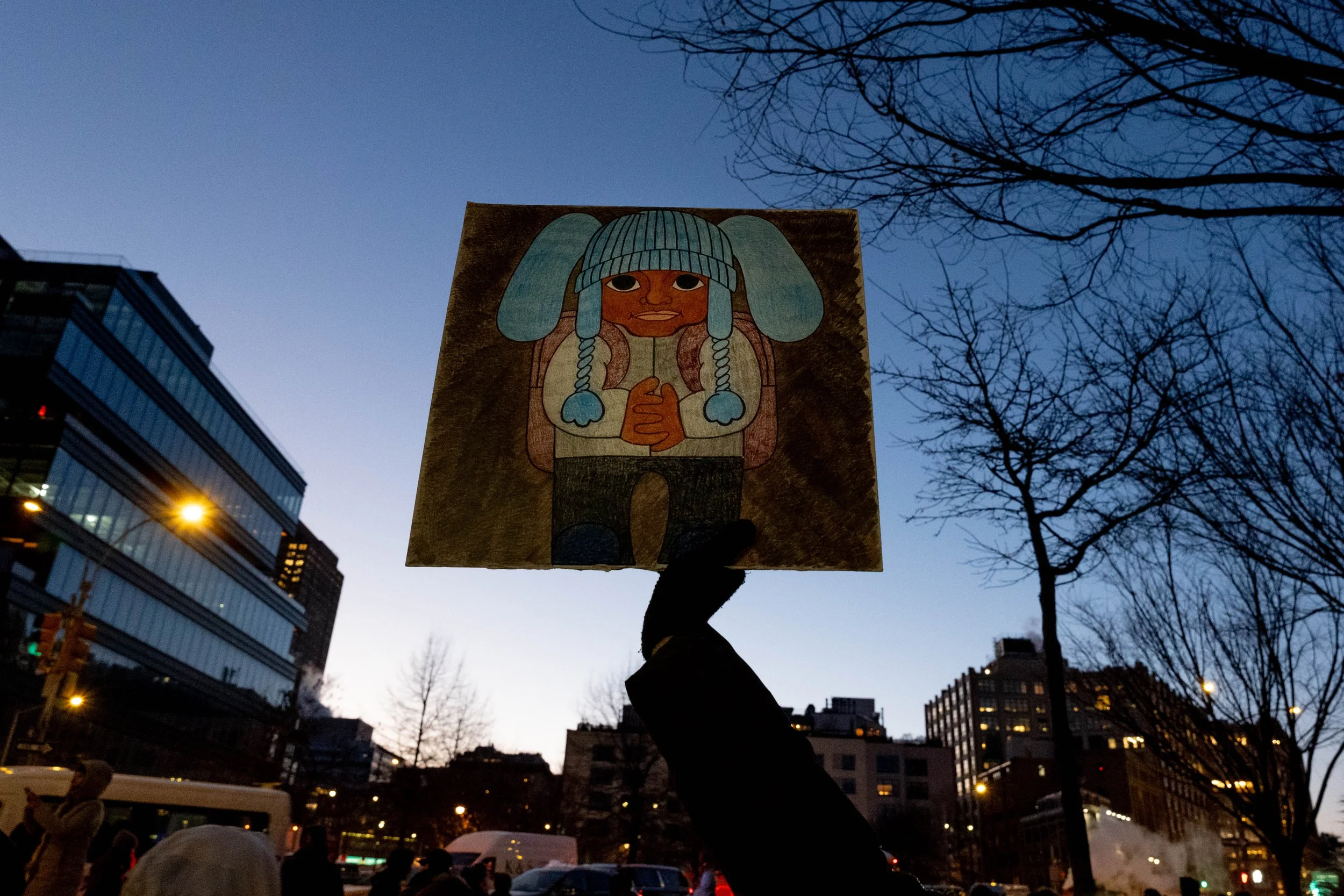
Protestors hold a hand drawn image of Liam Conejo Ramos, a 5 year old Kichwa-Otavalo boy was detained by ICE on January 20, 2026. His image circulated the internet causing anger and pressure to release him. January 30, 2026. New York City, NY
As our relatives and allies continue to be brutally kidnapped and murdered by ICE we are not going to placate the reasons why we don’t deserve to be criminalized before a system that already criminalized us from existence–if not the moment we crossed their artificial borders then from the moment we choose to value principles of collectivity and sovereignty over one of individualism and capital.
The persecution of Black, Indigenous, and all types of bodies "othered" by this system is an attempt to bring order through racial terror and the eradication of our dignity. Violence is and always will be the preferred language of the colonial state.
For indigenous peoples, the interests of the nation-state will never align with ours, as has been shown via the countless uprisings of our communities in Ecuador for centuries even including this past October 2025. From Kichwa Hatari, we name what we see: the criminalization of our right to exist, the violence inflicted on families, children, entire communities by ICE and the administration behind it. We name, too, the failure of the Ecuadorian state to advocate for and protect its own citizens.
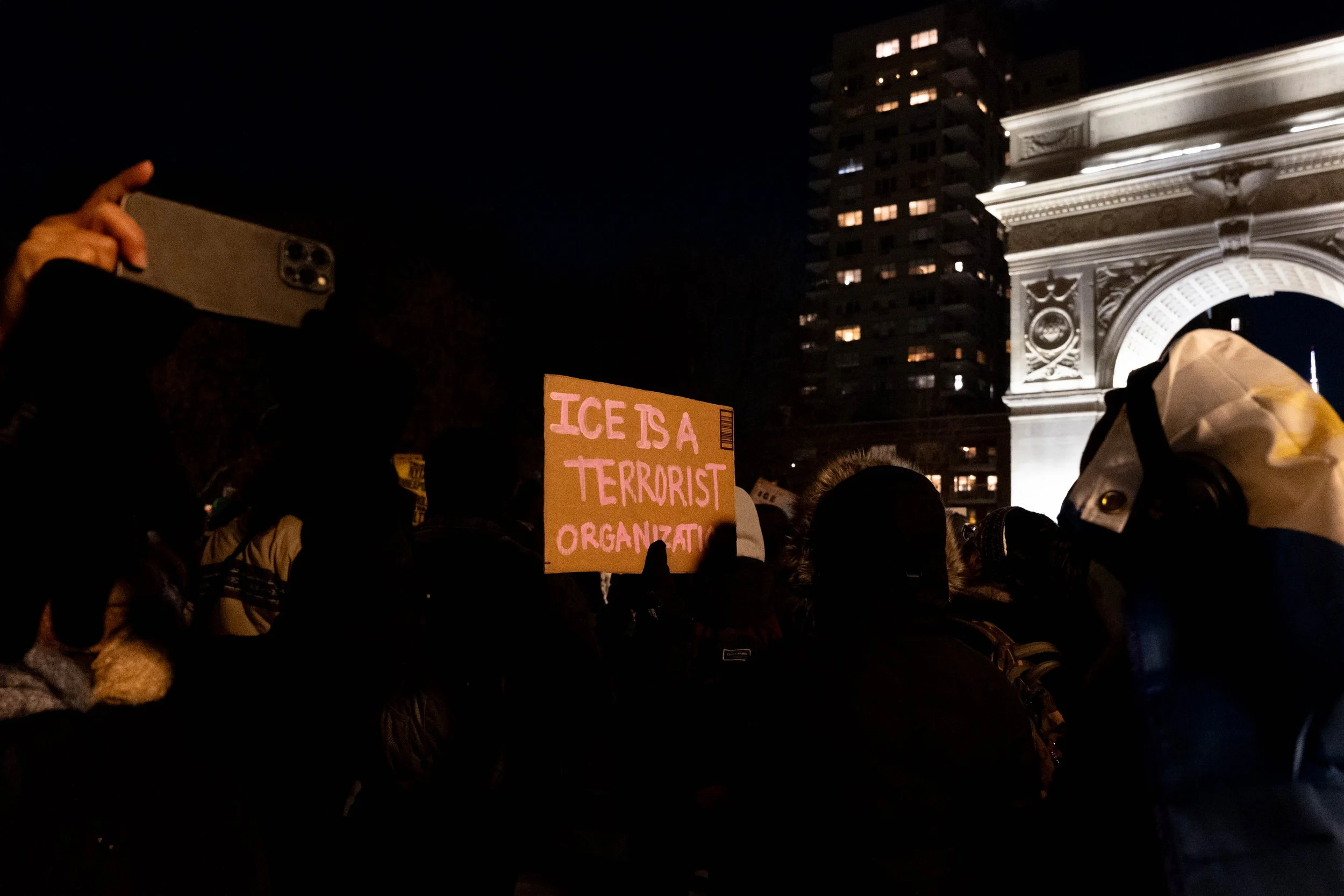
Protestor holds sign that reads "ICE is a terrorist organization" in the National Strike called by Minnesotans to denounce the brutality of ICE. January 30, 2026. New York City, NY.
Over the past five years, we have witnessed a wave of Kichwa migration to the U.S. These waves are born of government failure, economic insecurity, political persecution—the fruits of neoliberal and capitalist projects, colonial violence centuries old. It is the same violence we come to face up close when we migrate here. The same violence we flee migrate with us here, refashioned into policy, into dehumanizing rhetoric by this government and those who cheer it on.
As Indigenous peoples in diaspora, we carry a double burden. The instability, the violence, the persecution we escaped—it all travels with us, reconfigured into new forms of cruelty on this land.
The policies we face in the U.S. are violent, racist, and criminal. They weaponize our features, our skin color, and our accents to strip us of basic rights. All while the state justifies its abuse of power under the pretext of "security." But we ask ourselves: What danger does a 5-year-old child pose?
The repetitive use of terms like "illegal aliens," "criminals," "narcos" has normalized the conditions that allowed the violent arrest of Liam Conejo Ramos and his father Adrián Conejo Arias on January 20, 2026. It has also allowed the detention of hundreds of other children with and without their parents, as is the case of Elizabeth Zuna Caisaguano and her mother Rosa Caisaguano. This profound dehumanization is what allows ICE's brutality to run unchecked and funded by the U.S. government, endorsed by both parties—Republicans and Democrats alike. On January 21, ICE received a $75 billion increase for the next four years, on top of their current $10 billion annual budget.
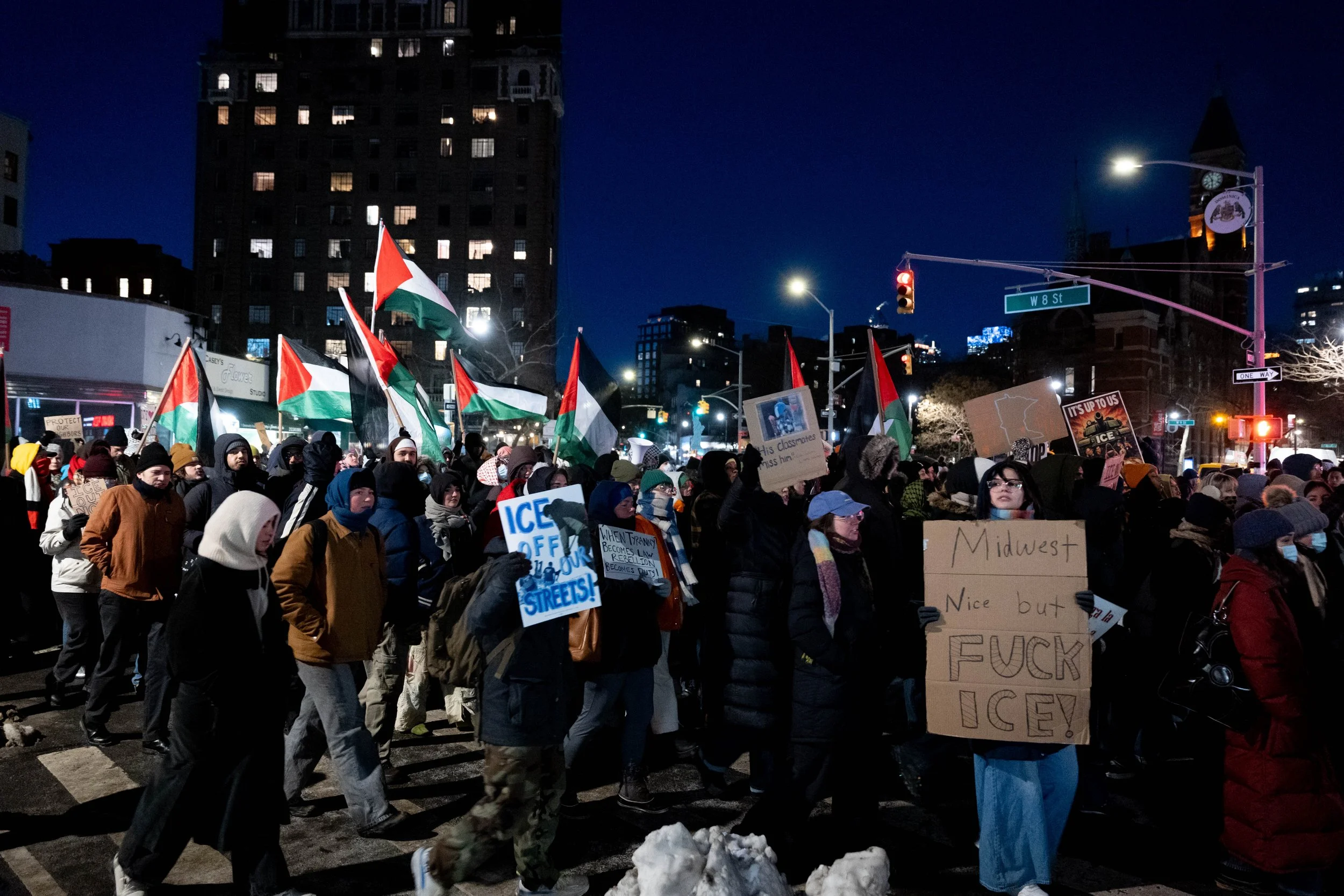
A coalition of social movements gathered and walked through the streets of New York City. January, 30, 2026
According to the Deportation Data Project, 23% of ICE arrestees through July 2025 in New York City were from Ecuador, far exceeding any other country of origin. Ecuadorians also accounted for more than a third (36%) of total ICE arrests in New York City in 2024. These alarming stats come at the heels of Daniel Noboa, Ecuador's president recently signing agreements with the U.S. to aid in the transfer and caging of asylum seekers— suffering commodified. Furthermore, Noboa has welcomed corporations like Palantir into Ecuador, a private surveillance and military security firm that profits from the dehumanization of migrants in the U.S. and Palestinians on their ancestral lands. Just as we learned in October 2025, the government of Noboa will never stand with the interests of the people, only of his own family. Our culture will be commodified and folklorized before its own bearers will ever be protected.
These past weeks, Minneapolis has become ground zero. Our feeds flood with footage of our people hunted by masked authorities, families calling for help in Kichwa, women weeping as their husbands are taken, children detained on their way to school or walking home—countless like Liam Conejo, Elizabeth Caisaguano. These families are treated as criminals, disappeared into detention centers under conditions so brutal many have compared them to conditions at Nazi concentration camps. This is where they take our people. At Dilley Detention Center in Texas alone, 3,800 children like Liam passed through in 2025. Children caged, torn from parents, relatives, community. The facility is currently experiencing a measles outbreak.
These detention centers are run by corporations with government ties—CoreCivic, GEO Group—profiting daily from our communities' suffering. According to Jacobin, companies running detention centers expect to receive $5.2 billion in capital and $520 million in profits in 2026. These are the same companies bankrolling Trump's campaigns.
A few days ago, Liam was released with his father. But we don't forget: the detention of a child is a violation of everything sacred. His wellbeing remains in the hands of those who criminalize his parents and his community. In our worldview, childhood represents the continuity of life and the legacy of our ancestors; to violate them is to attack the past, the present and future of our nations. Liam, a child from the Kichwa-Otavalo community, carries with him a rich cultural heritage and a legacy of resistance. At his young age, he has given us all a moment of pause and reflection on the brutality of this system. His image has circulated throughout the entire world, awakening the rage and indignation of many people who were moved by his innocence and the violence of his detention.
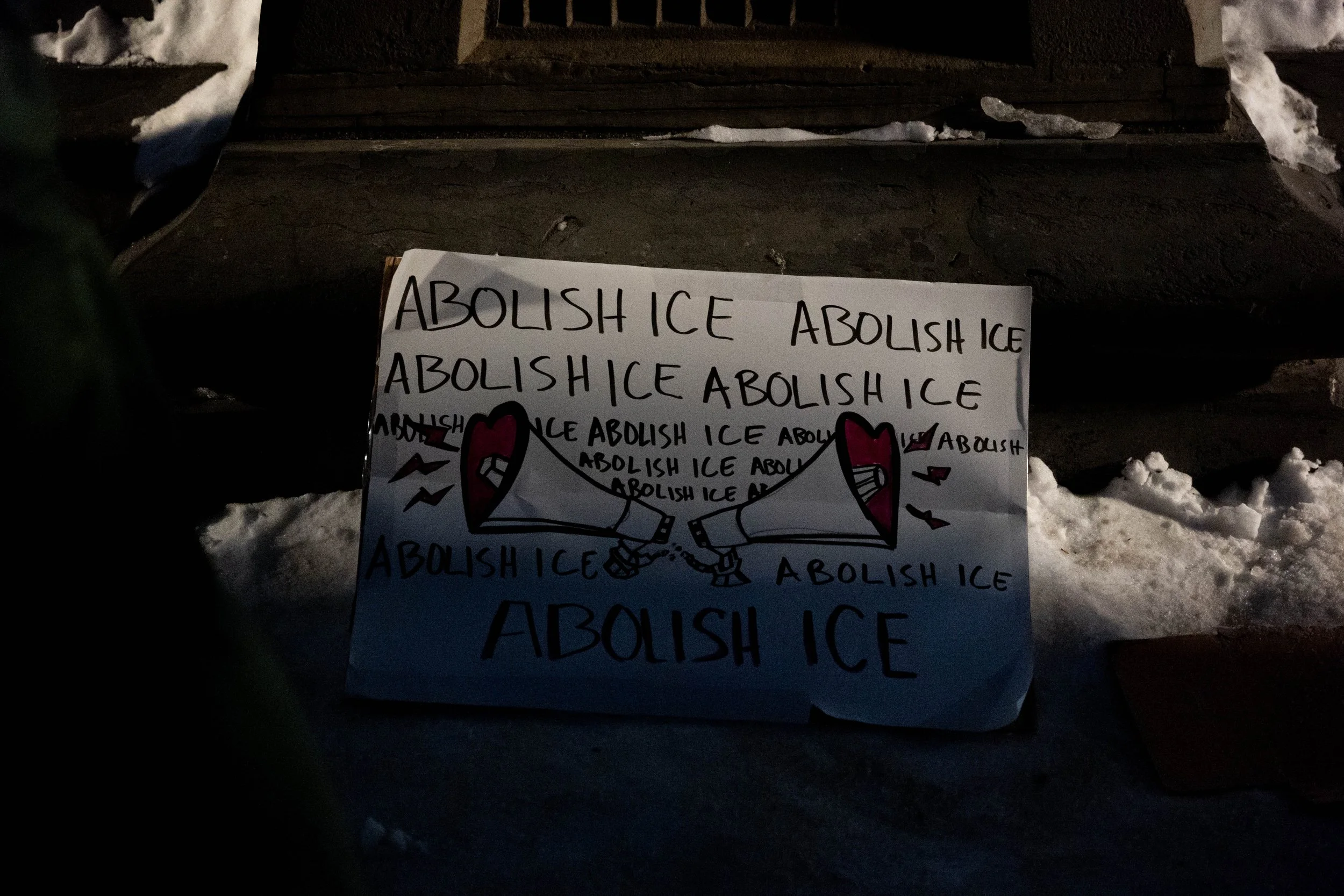
Abolish Ice. January 30, 2026. New York City, NY
A child of displaced Indigenous peoples carries double grief—a living cultural inheritance unraveling through migration and forced confinement, our future under siege. Language barriers, cultural erasure in detention centers, denial of medical care, of proper food— leave permanent trauma and deepen our dehumanization. Family separation, detention trauma: this is silent ethnocide.
We remind the world that the Universal Right to Human Mobility is, for us, an ancestral right. A right of the natural world and therefore of all living beings. A right that the Western world has criminalized to attack the most vulnerable. Our peoples walked these lands long before arbitrary borders were created on stolen territory belonging to Indigenous communities of North America—communities whose culture lives, whose resistance burns bright.
For Indigenous communities in the United States, whether native to this land or migrants to it, the road ahead is long. Our Native American relatives are currently being persecuted and arrested on their own ancestral territories, their ancient sovereignty trampled, their treaties with this country violated. In this moment of collective fear, of mounting insecurity, of fascism becoming normalized—we must fight from wherever we stand. We must keep weaving solidarity between Indigenous communities and our allies from all walks of life. We must remember who we are and the legacy of resistance we carry within. We must walk with the security that as our ancestors overcame we will too. We must stay informed, organized, aware of our rights, and nurtured collectively for what is to come.
We are living through darkness in the United States. Our guiding light is stubbornness to see ourselves in the future. A future where children like Liam Conejo and Elizabeth Caisaguano walk freely, play, attend school, and live without fear. Our solidarity is with Liam's family, Elizabeth's family, with their hearts, with the families of hundreds of other children whose names we'll never know. Childhood is sacred. Childhood deserves to be collectively cared for. And we must do all we can to remember that life is sacred.